
A torn anterior cruciate ligament (ACL) can cause knee instability, pain, and limit your ability to stay active. At All American Orthopedic & Sports Medicine Institute, our fellowship-trained orthopedic surgeons provide advanced ACL reconstruction using minimally invasive arthroscopic techniques and personalized treatment plans. Serving patients throughout Houston, Clear Lake, Lake Jackson, and Kingwood, we are committed to restoring knee stability, improving function, and helping you safely return to sports and everyday activities.
What is ACL Reconstruction?
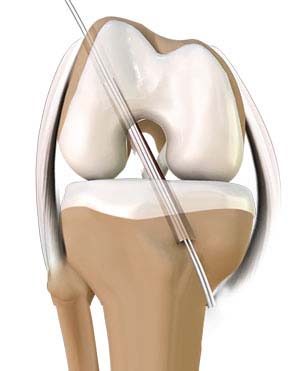
Anterior cruciate ligament (ACL) reconstruction is a surgical procedure to replace a torn or damaged ACL ligament in your knee with a new ACL tissue graft obtained most commonly from your own body (autograft) or in rare cases from a deceased donor (allograft).
The most common autografts are the patellar tendon (tendon of the kneecap) or one of the hamstring tendons (tendons located at the back of the thigh). In some instances, the quadriceps tendon located above the kneecap is utilized. Tendons are cords of strong fibrous tissue that connect muscles to bones. Ligaments are tough bands of tissue that connect one bone to another bone.
ACL tears or injuries most often occur during sports activities that involve pivoting, cutting, and turning movements as in football, soccer, skiing, tennis, and basketball.
What is ACL?
The anterior cruciate ligament is one of the major stabilizing ligaments in the knee. It is a strong rope-like structure located in the center of the knee, running from the femur (thighbone) to the tibia (shinbone). The ACL is one of the four major ligaments of the knee that connects the femur to the tibia and helps stabilize your knee joint. It prevents excessive forward movement of the tibia in relation to the femur as well as limits rotational movements of the knee. When this ligament tears, unfortunately, it does not heal on its own and often leads to the feeling of instability in the knee, requiring reconstruction to correct the abnormality.
What are the Indications for ACL Reconstruction?
An ACL tear or injury is the main indication for ACL reconstruction surgery. An ACL injury is a sports-related injury that occurs when the knee is forcefully twisted or hyper-extended. An ACL tear usually occurs with an abrupt directional change with the foot fixed on the ground or when the deceleration force crosses the knee. Changing direction rapidly, stopping suddenly, slowing down suddenly while running, landing from a jump incorrectly, and direct contact or collision, such as a football tackle can also result in injury to the ACL.
What Does Procedure for ACL Reconstruction Involve?
ACL reconstruction surgery is usually performed under general anesthesia using a minimally invasive arthroscopic technique. In general, the procedure involves the following steps:
- Your surgeon will make two to three small cuts, about 1/4-inch-long, around your knee.
- An arthroscope is inserted into the knee joint through one of the incisions.
- An arthroscope is a thin tubular instrument with a camera, light, and a magnifying lens attached at the end that is connected to an external monitor and enables your surgeon to view the inside of the knee joint.
- Along with the arthroscope, a sterile solution is pumped into the joint to expand it, enabling your surgeon to have a clear view and space to work inside the joint.
- Miniature surgical instruments are passed through the other incisions and the torn ACL is removed and the pathway for the new ACL tendon graft is prepared.
- Your surgeon makes an incision over the knee or hamstring area and takes out a part of the patellar, hamstring, or quadriceps tendon to prepare the new ACL graft.
- Small holes are drilled into the upper and lower leg bones (femur and tibia) where these bones come together at the knee joint. The holes form tunnels in your bone to accept the new graft.
- The graft is pulled through the predrilled holes in the femur and tibia and fixed into the bones with screws or suture anchors.
- After confirming satisfactory reconstruction, the scope and the instruments are withdrawn, and the incisions are sutured and bandaged.
What Does Postoperative Care for ACL Reconsturction Involve?
In general, postoperative care instructions and recovery after ACL reconstruction surgery will involve the following:
- You will be transferred to the recovery area where your nurse will closely observe you for any allergic or anesthetic reactions and monitor your vital signs as you recover.
- You may notice pain, swelling, and discomfort in the knee area. Pain and anti-inflammatory medications are provided as needed to keep you comfortable.
- You are advised to keep your leg elevated while resting to prevent swelling and pain.
- You will be given assistive devices such as crutches with instructions on restricted weight-bearing for a specified period of time. You are encouraged to walk with assistance as frequently as possible to prevent blood clots.
- Instructions on surgical site care and bathing will be provided to keep the wound clean and dry.
- Refrain from strenuous activities for the first few months and lifting heavy weights for at least 6 months. A gradual increase in activities is recommended.
- An individualized physical therapy protocol will be designed to help strengthen the knee muscles and optimize knee function.
- You will be able to resume your normal daily activities in a couple of months, but with certain activity restrictions. Full recovery and return to sports usually take about 9 to 12 months.
- You may return to your work in about 6 weeks if your job is not too physically demanding. Those with physically demanding jobs will require a longer recovery period.
- A periodic follow-up appointment will be scheduled to monitor your progress.
What are the Risks and Complications of ACL Reconstruction?
ACL reconstruction surgery is a relatively safe procedure; however, as with any surgery, some risks and complications may occur, such as the following:
- Infection
- Bleeding
- Pain and weakness in the knee
- Adverse reactions to anesthesia
- Blood clot or deep vein thrombosis
- Damage to adjacent soft tissue structures
- Stiffness or decreased range of motion
- Re-rupture of the graft
- Non-healing of the ligament
Why Choose All American Orthopedic Surgeons for ACL Reconstruction in Houston, Lake Jackson & Kingwood?
A torn ACL can significantly affect your mobility, athletic performance, and overall quality of life. At All American Orthopedic & Sports Medicine Institute, our fellowship-trained orthopedic surgeons specialize in diagnosing and treating ACL injuries with advanced arthroscopic reconstruction techniques designed to restore knee stability and function. Whether your injury occurred during sports, exercise, or an accident, we develop a personalized treatment plan based on your goals, activity level, and lifestyle.
Patients choose our orthopedic team because we offer:
- Fellowship-trained orthopedic surgeons with expertise in sports medicine and knee ligament reconstruction
- Advanced arthroscopic ACL reconstruction techniques using minimally invasive procedures
- Comprehensive diagnostic evaluations, including advanced imaging when needed
- Personalized treatment plans based on your age, activity level, and recovery goals
- Treatment for associated meniscus, cartilage, and other knee ligament injuries
- Coordinated rehabilitation programs to optimize recovery and return to activity
- Convenient locations in Houston (Clear Lake), Lake Jackson, and Kingwood
Our goal is to restore knee stability, reduce pain, and help you confidently return to work, sports, and the activities you enjoy.
ACL Reconstruction FAQs
What is ACL reconstruction?
ACL reconstruction is a surgical procedure that replaces a torn anterior cruciate ligament with a tissue graft to restore stability and function to the knee. The procedure is typically performed using minimally invasive arthroscopic techniques.
When is ACL reconstruction recommended?
Surgery may be recommended for patients with complete ACL tears, persistent knee instability, active individuals who wish to return to sports involving cutting or pivoting movements, or those with associated meniscus or cartilage injuries. The decision is based on your symptoms, lifestyle, and treatment goals.
What type of graft is used during ACL reconstruction?
Several graft options are available, including your own tendon (autograft), such as the patellar tendon, hamstring tendon, or quadriceps tendon, as well as donor tissue (allograft). Your orthopedic surgeon will recommend the most appropriate graft based on your age, activity level, and individual needs.
Is ACL reconstruction performed arthroscopically?
Yes. Most ACL reconstruction procedures are performed arthroscopically through small incisions using a tiny camera and specialized instruments. This minimally invasive approach typically results in less tissue disruption and supports recovery.
How long does recovery take?
Recovery varies for every patient. Many patients begin physical therapy shortly after surgery, while returning to sports or high-impact activities generally requires several months of rehabilitation. Your surgeon will monitor your progress and determine when it is safe to resume specific activities.
Will I need physical therapy?
Yes. Rehabilitation is one of the most important parts of ACL recovery. Physical therapy helps restore knee motion, strength, balance, and stability while preparing you for a safe return to daily activities and sports.
Can I return to sports after ACL reconstruction?
Many patients are able to return to their previous level of athletic activity following successful surgery and rehabilitation. Your return-to-sport timeline depends on your healing, strength, knee function, and your surgeon's evaluation.
Restore Knee Stability with Expert ACL Reconstruction
If knee instability or an ACL injury is preventing you from staying active, the orthopedic team at All American Orthopedic & Sports Medicine Institute is here to help. Our fellowship-trained orthopedic surgeons provide comprehensive evaluation, advanced arthroscopic ACL reconstruction, and individualized rehabilitation plans designed to help you recover with confidence.
With convenient locations in Houston (Clear Lake), Lake Jackson, and Kingwood, expert orthopedic care is always close to home. Contact All American Orthopedic & Sports Medicine Institute today to schedule your consultation and learn whether ACL reconstruction is the right treatment for your knee injury.