
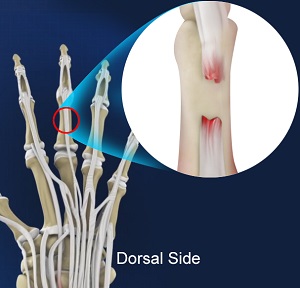
What are Extensor Tendon Injuries?
Extensor tendon injuries refer to damage or a tear in the tendons located at the back of the hand and fingers. These tendons are responsible for extending or straightening the fingers.
Causes of Extensor Tendon Injuries
The most common causes for extensor tendon injuries are accidents and injuries. Other causes include the following:
- Deep cuts: Serious cuts into the back of your hand that damage the tendons
- Sports Injuries: Trauma sustained while playing sports, especially ball sports
- Finger jamming: A direct and forceful impact on the fingers that jams the finger
- Bites: Trauma from animal or human bites
- Rheumatoid arthritis: Joint inflammation causing chronic damage
Symptoms of Extensor Tendon Injuries
Symptoms of extensor tendon injuries include the following:
- Drooping finger: Inability to fully straighten your finger
- Weakness: Diminished grip strength
- Stiffness: Reduced range of motion in the finger
- Pain and tenderness: Distress in the finger bones and joints
Diagnosis of Extensor Tendon Injuries
Your doctor will review your medical history and symptoms and perform a physical examination as necessary. The following diagnostic tests may be ordered:
- X-rays: This imaging study uses radiation to detect any damage to the bone.
- Magnetic Resonance Imaging (MRI) Scan: This is an imaging study that uses a large magnetic field and radio waves to detect any damage to soft tissue structures.
- Ultrasound: This test produces images of the soft tissues and joints in the hand using high-frequency sound waves.
Treatment for Extensor Tendon Injuries
The treatment for extensor tendon injuries varies, depending on the severity and the cause, and includes the following:
- Splints: Applying a splint to immobilize the hand while it heals.
- Medications: Your doctor may recommend over-the-counter medications or prescription medications to reduce pain and inflammation.
- Wound Management: Treating any cuts or bites in order to avoid infection.
- Physical therapy: Your doctor may recommend physical therapy to strengthen muscles and relieve joint stiffness to restore functional ability and movement.
- Surgery: In severe cases or when conservative treatment fails, your doctor will recommend surgery to repair the torn tendon.